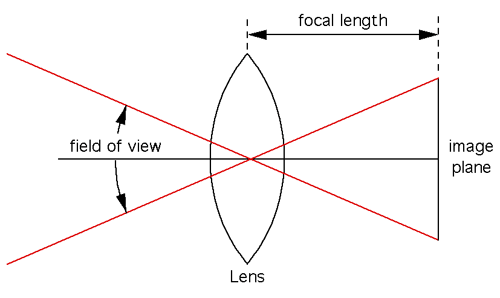
Angle of view- The area of a scene that a lens
covers or sees. It is determined by the focal length of the lens. A wide angle
lens (short focal length) includes more of the scene- a wider angle of view-
than a normal (normal focal length) or telephoto (long focal-length).
Colour negative- When
shooting in colour film, the negative will show exact opposites of the original
colour. When printed to photographic paper, the negative becomes a positive and
shows in full colour on the print.
Composition – Putting
together various visual elements to create a unique organization or grouping to
achieve a unified image or photograph.
Depth of
Field – The area between the nearest and
furthest objects that appear to be in focus. This technique is controlled by
the aperture of a camera lens.
Exposure – The
amount of light that is allowed to hit photo film or photo paper, creating an
image on the respective source.
Film
Speed – The number given to
various films to describe how fast the film can capture an image when exposed
to light. This number is most commonly referred to as the International
Organization for Standardization (ISO) film speed.
Focal
Length – The distance between the point of focus and the film
plane when the lens is focused at infinity. Lenses generally have the focal
length engraved on the front of the lens and is expressed in millimetres.
Grain – Fine
silver crystals in the light-sensitive emulsion of film that react when exposed
to light and turn black. The slower the film speed the finer the grain and the
faster the film speed the more present the grain. Larger film formats can be
enlarged without much grain is noticed whereas 35mm formats may see noticeable
grain beyond an 8 x 10 inch print.
Lens – The lens
is a combination of pieces of glass with curved surfaces that receive light
rays from an object and are able to form an image on the focal plane. A lens
may have variable vocal lengths for zooming, macro, or wide angle shots.
Reflex
Camera – A camera with a mirror directly behind the lens
that captures the image and reflects the image to a viewing screen.
Parallax
Error – An instance where the camera lens and viewfinder
do not see the exact same frame, causing the photographer to compensate for the
offset. Close-up photography suffers heavily from the parallax error as it
makes it difficult to compensate and focus correctly. Problematic for
viewfinder cameras or twin-lens reflex cameras.
Single-Lens
Reflex – A camera with a single lens that is used for viewing
and capturing the image. The image is reflected with a moveable mirror in the
camera body that allows the photographer to see directly through the lens. The
mirror flips up when the shutter is opened to allow light to expose the film.
Viewfinder – The viewing device on the camera that allows the
photographer to see the approximate or exact view of the camera’s lens. Only
single-lens reflex cameras give the user the ability to see exactly what the
camera sees.
Zone System – An exposure method
developed by photographer Ansel Adams for determining optimal exposure and
development for each negative.
Latent image- The invisible image
left by the action of light on photographic film or paper. The light changes
the photosensitive salts to varying degrees depending on the amount of light
striking them. When processed, this latent image will become a visible image
either in reversed tones (negative) or in positive tones (colour slide).